Monday, May 31, 2010

week ten: sculpting...


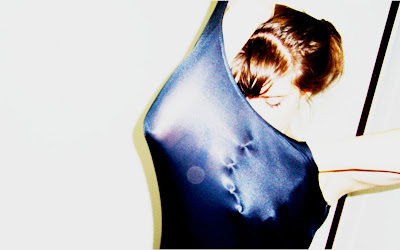
Cami James (RMIT 4th Year 2009 final collection, Oyster magazine)

This specific body piece is minimal yet forceful in impact. The detail confined to the molded torso grabs your attention through its light reflecting properties, highlighting its polished finish. It creates a new form for the body, accentuating its original form by extending out to a new degree.

It underlines the concept of the 'hard body', much like Issey Miyake's molded plastic bustier, 1980, as it imitates the body yet displays a hard powerful shell on the wearer. It explains the relationship between the body's form and the garment directly in contact with it. Reversing the idea that clothing clads or conceals the body, this piece replicates the body, exposing it like a second skin compiled of plastic. This bustier created by Cami is dramatic with its reflective surface and sinuous curves can also be appreciated as a sculpture with its own form and function.

I am drawn to this concept, intrigued by its potential response to stretch fabrication, and wish to possible it explore it in the remaining weeks of the project. The consideration of depth and dimension is all part of construction preparation and process in context to both corsetry and stretch fabrics, therefore I aim to illustrate the parallels between the two.

(above images from http://www.nodiscount.com.au/blog/page/4/ viewed 17/4/10)

week ten: corsetry...


A corset is a garment worn to mold and shape the torso into a desired shape for aesthetic or medical purposes. In recent years, the term "corset" has also been borrowed by the fashion industry to refer to tops which, to varying degrees mimic the look of traditional corsets without actually acting as one. While these modern corsets and corset top often feature lacing and/or boning and generally mimic a historical style of corsets, they have very little if any effect on the shape of the wearer's body.

The most common and well-known use of corsets is to slim the body and make it conform to a fashionable silhouette. For women this most frequently emphasizes a curvy figure, by reducing the waist, and thereby exaggerating the bust and hips. A shorter kind of corset, which covers the waist area (from low on the ribs to just above the hips), is called a waist cincher. A waist cincher (sometimes referred to as a Waspie) is a belt worn around the waist to make the wearer's waist physically smaller, to create the illusion of being smaller.

A corset has the influence to command the awareness of those around. It highlights the centre, the core of the skeletons frame. It protects the cluster of importance within the body, becoming a supportive armor. The chosen shape of a corset determines its power over the body. It most classically creates the hourglass figure desired by females, accentuating aspects of the form as to better shape. It ultimately crafts a smooth, reduced waistline which contours are rounded off to the hips.


(Above images www.iainclaridge.co.uk/. ../babyphat_dm.jpg, viewed 8/5/10)

Monday, May 17, 2010

week nine: dolls...


A study of the basic physical aspects of the female body was essential in order to comprehend its full influence on the way that I design. Focus is placed upon definite components that construct and shape a defined silhouette. This absolute profile of the female figure discloses a sense of command, suggestiveness and splendor, all in the one frame.

The Female body shape is the cumulative product of a woman's skeletal structure (build) and the quantity and distribution of muscle and fat on the body. There are, and have been, wide differences on what should be considered an ideal or preferred body shape, both for attractiveness and for health reasons. These have varied among cultures and at different times. As with most physical traits, there is a wide range of normality of female body shapes.

Human beings and their cultures have perennially focused attention on the female body as a source of aesthetic pleasure, sexual attraction, fertility, and reproduction. The female body occurs in a range of shapes. The female figure is typically narrower at the waist than at the bust and hips, and usually has one of four basic shapes: banana, pear, apple or hourglass. The bust, waist, and hips are called inflection points, and the ratios of their circumferences define these basic shapes. Usually, the bust area will depend on the person's weight and height.

Alteration of the body shape

Various strategies are sometimes employed to temporarily or permanently alter the shape of a body. At times artificial devices are used or surgery is employed. Breast size can be artificially increased or decreased. Breast Prostheses or padded Bras may be used to increase the apparent size of a woman's breasts, while minimiser bras may be used to reduce the apparent size.

Historically, the greatest efforts have been made to reduce a woman's waist line. Boned corsets were used for several centuries, but during the twentieth century these were mostly replaced with more flexible foundation garments. Where corsets are used for waist reduction, it may be temporary reduction by occasional use or permanent reduction by people who are often referred to as tightlacers. Liposuction is the common surgical method of reducing the waist size.

Padded control briefs or hip and buttock padding may be used to increase the apparent size of hips and buttocks. Buttock augmentation surgery may be used to increase the size of hips and buttocks and to make them more rounded.

Women simply aspire to amplify and intensify their natural physic to craft the ideal body. I intend to simply emphasis its form by honoring its imperative fundamentals. This will be carried out through the arrangement of colour and fabrication to mold and highlight features.

Saturday, April 24, 2010

week seven: neo...


Neoprene or Polychloroprene is a family of synthetic rubber that are produced polymerization of chloroprene. Neoprene is an oil and water resistant material that was designed as a alternative to natural rubber. This stretchy rubbery material is encased in nylon that offers incredible flexibility, support, warmth and insulation. Neoprene is primarily used for wetsuits, but has also found its way into many types of active wear and other everyday item, reflecting its utilitarian style.


Working with neoprene is a entirely new 'stretch' experience. It's thick and solid structure makes for a temperamental sewing experience, as seams slip under the machine foot with the slightest movement. Neoprene fabrics has two facets not only physically but metaphorically. Its dense composition provides both intense stretch and control on the form, as well as volume and structure from its firm handle.


Friday, April 16, 2010

week six: image development


This image that I used in my project presentation summarizes my generic investigation findings in the way that it captures a moment of movement where the garment is responding. It shows the extension and length that the nylon spandex has reach simply by force or energy. The power that the body has to form unique and unusual shapes when confined by a fabric will always manifests a novel silhouette. Here the model progresses inside the structure of the swimsuit, as she tries to cover or even hide herself within it, intensifying its prime form. The distinct points of pressure that her fingers have create are highlighted by the contrast of black and white extremities within the photo. My approach was to strip all colour and tone in order to simplify this image to present it in its rawest form, exposing the effortlessness of this particular stretch fabric and its initial reaction to the body.

Not only was the presentation of the five images which best portrayed my generic investigation beneficial for me, but I enjoyed taking in the design concepts and course of others. For each person to voice their individual hypothesis on the hub of 'stretch generics' and therefore generic garments was personally a motivating moment. The disparity in the theory of each students was absorbing along with their chosen visual aid which validated and exhibited those notions that they were articulating.

Thursday, April 1, 2010

week five: swimmers...


A swimsuit, bathing suit, togs or swimming costume is an item of clothing that is tight-fitted and designed to be worn while participating in water sports of leisure activities. For women, the swimsuit is either a two-piece top and bottom ensemble or a one-piece maillot style. The first swimsuits concealed most of the body, women wore bloomers, black stockings, and a dress with short sleeves or shirt. Today women's 'bathers' are generally bikinis, one-piece variations or thongs, with the intension to reveal as much as the body as possible without actual nudity.

The concept of developing my own design approach for experimentation with the swim suit seemed challenging. I was drawn to follow up on my recently explored performance enhancing fabrics, as I found that this could become a strong approach for this weeks exercise. Unlike regular swimsuits, which are designed mainly for the physical appearances, competitive swimwear is manufactured for the purpose of aiding athletes, increasing their efficiency . Parallel to this is the utilization of wetsuits produced from foamed neoprene that insulate the wearer and provide them with buoyancy in the sometimes harsh sea conditions.

With all this in mind I had the idea to incorporate neoprene into my design, but not as proficiently as it is intended for. The type of design I want to form may not be wearable for water purposes or even practical. This 'Avant-Garde' approach is something that I want to explore in the next project, especially as I will be carrying out the construction of the experimental swimsuit from week 7 onwards. It will assist me in launching into a new design direction as the foundation can be extended further than one weeks work, giving me strong support to initiate more toile's from.

Russh Magazine Issue 32- Swimwear Shoot (January. February 2010)


This album of images featured in this Russh photo shoot merges athleticism and femininity together to form a powerful compilation of swim and sports wear that has inspired me to

After speaking to my friend grace in 3rd year about my project direction, she guided me to a designer called Lisa Marie Fernandez. Once I had viewed her recent collection it was evident that it related to my design direction, with its blocked colours and of course fabrication. As a designer reference she follows the same fundamentals that I am wanting to attain in the way she uses an innovative fabric that is made to perform, molding the body's form whether creating curves or supporting them.


'The collection takes its cues from the bold, colour-blocked suits of the eighties but the look is totally modern. with their chunky zips and taut silhouette, there's a strong sexiness to them thats bonafide Bond girl. But the clean design of the various styles subtly adapted to each wearer's individual aesthetic, from the sunbather to surfer. LMF bikinis can be directional, sporty, sophisticated and glamorous. The modular collection has various colours and styles that are made to endlessly coordinate.'

(above image http://www.lisamariefernandez.com/main.html viewed 2/4/10)

week four: beautify me...


To decorate is to make something more attractive by adding ornament, embellishment, adornment or even colour. Decoration is something intended to increase beauty or distinction within a specific object or space. The act of decorating is something that may involve the addition of flounces, frill, ribbon, trimming, bows, puffs and other forms of texture. In other words the process of attaching decoration can be described as 'garnishing,' especially in relation to fashion items thats base shape has already been established.

Fashion in the 18th Century in European and European-influenced countries reached heights of fantasy and abundant ornamentation, especially among the aristocracy of France. Specifically the Rococo period dating from 1715-1774, which was marked stylistically by the same convoluted detail and elaborate decoration, which characterized the Baroque period immediately preceding it. Rococo style was highly dominated by classical feminine taste and influences. This Fashion century proves as an ideal reference in my attempt to expose the subject matter of decoration. Producing such influential characters as Marie Antoinette, who in many ways has been inspiration for designers and artists in the creation of new and contemporary work for century's.


During my findings I stumbling across a book out of my collection named 'Style Deficit Disorder' which is devoted to Harajuku street fashion in Tokyo. It highlights the neighborhoods dizzy combination of street-level fashion, outre couture, and re-mixed, fashion-forward youth culture which has made it an international style capital. Within this the specific, but popular style of the Baby and Lolita movement was revealed to me as a significant influence in my approach to this decorative task. These styles were influenced by designer Isao Kaneko and his romantic Victorian-meets-Little house on the Prairie style outfits that could only be described as lovely, pink and ruffled. This clothing found a silhouette that was a playful and abundant contrast to the form-fitted, sleek aesthetic that was popular at the time. This particular Harajuku style is not afraid to deliver that over-the-top element that was required for this weeks design task, therefore stimulating me to resolve my toile with the same approach.


My decorated Nana is simple in terms of construction, but very laboring when it came to the creation and placement of the frills. The frilling is positioned in rows over the entire back pattern piece and create a bustle-like flounce of fabric.To highlight the use of multiple layering, I used a sheer nylon (fairy floss) net to generate a subtle variation in tone as well as incorporate a 'fresh' texture in the design. The choice to not go down the path of predictability and produce this garment using girly, feminine, powder pink fabric came from the theory to remain sophisticated and even mysterious through the use of a dark and moody fabric. The Nylon Lycra I used embraces a certain level of intensity which I wanted to achieve, not only through its high stretch qualities, but its lustrous and sleek surface, which reflects with every shift in movement. Experimenting with such high tenacity fabrications has allowed me to further explore the concept of the body conscious garment and its power to control and mold the body, especially being that the brief sits so intimately to the bodies figure, having a stronger influence. The combination of the front design lines and the thick off white elastic that frames the briefs outline engages a masculine side in the way that it evokes a traditional men's Y front underwear. This observation only came after the completion of the garment, as its symmetry and shape almost mocks or imitates the simplicity of conventional underwear with its excessive and impractical adornment.


(above images http://www.dirjournal.com/info/wp-content/uploads/2009/05/1.jpg, rubypr.com/.../2008/ 11/fruits-umbrella.jpg viewed 3/4/10)